Wednesday, 13 February 2013

Some Street Photography Research


Gary Tyson

http://erickimphotography.com/blog/2012/09/from-military-photographer-to-street-photographer-interview-with-gary-tyson-from-hong-kong/

I read an online interview with the street photographer Gary Tyson in preparation for my shoot tomorrow. In my last shoot, I did not intentionally go out to capture images of the public, but rather took photographs of moments which interested me. This time I will be outwardly approaching people and asking to taking their photo, as well as shooting them whilst they are unaware. The part of the interview which really stood out to me was with relation to how to cooperate with participants, and how to come across or behave when photographing. Here is an extract from the interview:


(referring to the fast-changing conditions of military photography, in which he began his photographic career) This ethos works well for photography as well as many other aspects of life, and helps me adapt quickly to changing situations. I think this is a critical skillset whilst shooting on the street also, being able to ‘observe and react’ quickly before the moment passes. Being ‘streetwise’ I think is almost as important as being able to see a good image, they go hand in hand when shooting the streets, whether you choose to blend in and shoot silently and discreetly as is the preferred method of many, or whether you choose the ‘Bruce Gilden’ approach of flashing your subjects in the face.
Of course there is a lot of debate about this method….I personally find that I shoot whichever mode suits my mood…..I worry about the image first, then the consequences, some may not favour that approach, my view is that if you worry too much about any possible confrontation (usually a self imposed fear), then you will never get the intense, close up images you desire), overcome your fears, and you shall succeed, people don’t bite…well at least not always.
As I will be trying to attain shots of people unaware, matched with conscious ones, I will have to adopt two different styles. I will try to be discreet by shooting from a distance or perhaps by pretending to photograph an object or building in the foreground/background. I researched further into the "Bruce Gilden" approach that Tyson refers to in this section of the interview and found that he "routinely uses a flash, alerting his subjects to his presence, unlike most street photographers." (Wikipedia) and has photographed the homeless, prostitutes and bike gang members. I feel that this approach may incite anger as the participant has not consented to being photographed. In saying this, however, it is perhaps morally better than photographing them completely unaware, but the whole idea behind my project is the comparison between the natural and the performed, and if people are aware of my presence and photographing then they may well act differently. I have learned from this section to be confident and approachable, and more importantly to be quick to capture a naturalistic moment in time.

I found this part of the interview very interesting also:
4. What are some of the challenges you find shooting street photography in Hong Kong? As a foreigner, are people open to being photographed or are quite against it?
Shooting in Hong Kong is generally quite easy I find. For me its all about projection…If you project yourself in a positive, friendly manner, you won’t get much problem, if you over react to somebody who doesn’t want to be photographed, things will quickly deteriorate, this applies anywhere in the world as far as I’m concerned.
Some Hong Kongers aren’t keen on being photographed, particularly the elderely can be grumpy sometimes, there are some traditions I’ve heard of beliefs that their soul is being stolen if photographed by a ‘Gweilo’ (westerner), but I’m not sure how true these myths are, as others have told me there is no such thing. I guess you just need to try and respect peoples wishes, or shoot from the hip so they don’t know or need to care what you are doing.
From this I know I must be sensitive towards peoples feelings and to be sure about what I want from my photograph. I am not sure whether I will be able to shoot from hip level as it will be complicated to focus on a subject (even with autofocus) and thus the photo may come out to a lower quality. 

Gary Tyson also speaks about the camera's he uses and states that: "For my street photography I started off with the DSLRs, but found them too big and noisy..." I will be using a DSLR (Nikon D7000) and thus will have to be very subtle when photographing people unaware, in order to get the most realistic depiction. 

I also was intrigued by this part of the interview:

9. Who are some photographers (classic and contemporary) who have influenced your photography.

I must admit I’m not the kind of photographer who dives into books and studies other photographers work. I see images every day from people who I’ve never heard of that blow me away on places like 500px, etc. I am not from the school of having to emulate the classics or anyones styles. If I see an image I love, I may try to emulate it in some form and apply my own twist on it, but honestly I have too many visions going around in my own head to try and memorise everyone elses.
I don’t study photography in the classic form, I have some friends who are the complete opposite to me, I personally don’t think it matters where or how you learned your craft, when I look at a photo, I don’t ask if the photographer has a degree, went to a certain school, or has read the life and times of HCB–its completely irrelevant to me. I want the image to talk to me–thats more interesting.


Matt Stuart - Street Photographer
I really like the comedic aspects of these photographs and the fact that Stuart was so dedicated to street photography and patient in order to attain these humorous and ironic snapshots of London life. He undercuts the seriousness of city business men by placating them walking next to a lowly pigeon, as well as showing how a business man gains pleasure from voyeuristic acts, in the form of the FHM magazine which surreptitiously pokes out of his bag. I hope to bring this type of humorous energy and vibrancy to my photographs when shooting tomorrow.


Documentary Experimentation

Last week I booked the Nikon D7000 and took it with me on a journey throughout Camden with my friend. I took a series of photographs of situations and occurances that inspired me. These are a few of my (unedited) favourites:


I feel that these first three photo's are representative of Camden in terms of it's atmosphere - from the barrage of stools lining the road and the markets selling a variety of products, to the artistic and creative nature of the town on the whole. It's shabby sheek vibe, and mixture of people from tourists to residents and the social/cultural range of people, there was ample opportunity to capture some interesting moments. There is a haphazardness and hullabaloo to the town, which I feel is conveyed in this image set. These three images work well together in the sense that most of those featured in it are obscured facially, leaving the viewer to interpret their emotions or thoughts based on their contextual location and the information surrounding them as well as from their stance and body language. I feel that the 3rd photo could benefit from being taken slightly to the left and further back, to show the space in which the subject is staring into, whilst still including the art work and thus pertaining to the rule of thirds (art work - right, subject - centre, subjects attention - left)


The above 4 photo's display the food stalls of Camden. Although the second image is blurred, I feel this adds to the ambience, as this area - and the town on the whole- is very fast-paced and upbeat. This is reflected in the apparent hard-sell from the man in the 3rd image, who tries to grab the attention of the fast moving public. I feel that the 3rd image isn't technically sufficient, however, as it is slightly out of focus and dark. It could have perhaps benefited from a higher ISO level and a re-focus. The fourth photograph is one of my favourites in this collection as it is evokes humour and has many levels to it. During the day, the subject in the centre approached me, upon seeing my camera, and told me to take a photograph of him. He then struck this interesting pose as the customers that he was serving looked on in amusement. I think technically this image is good as it is sharp, however perhaps I could have it shifted to the right or stood back slightly as the subjects hand has been cut off. Also the shadow covering his face could have been removed if he'd moved forward slightly, from beneath the food-stalls canopy; thereby lighting his face and highlighting his prominence in the photo in comparison to the customers in the shadows - however, due to the spontaneity of the photograph, I did not have a chance to correct these elements - and also I feel that the shadow adds to the performed menace that the subject was aiming to present. This image stands alone from the others as it is quite ambiguous and complicated to define in terms of its style. Arguably it could be thought of as documentary or portraiture, or even a mix. I like the way that this subject performs in front of the camera and found it interesting that he had a preconceived idea about the camera being a medium for self-representation, and the way the customers in the photo's eye-line is drawn towards the camera, and not the actual person being photographed. I felt that throughout the day many people looked at the camera regularly, seemingly intruiged by it, or more prominently, by it's (or my) ability to represent them in a certain way. After spotting it many looked away immediately, perhaps as they didn't feel 'prepared' to be photographed. I think that the idea of performance in front of the camera will be one that I wish to explore further within my project.


I found the above 3 images interesting especially because of the relationship that is portrayed between the lady and the girl in the middle. They were chatting and laughing and seemed to be quite close. Everyone in this image was waiting to cross the road, whilst I was on the opposite side. I feel that these two ladies stood out amongst others - whose facial expressions were more weary or focused or blank, and I like these images as they are brief snapshots in time, which is reinforced by the traffic lights next to them, connoting the short time that they had to wait to cross the road. They bought life to the photograph and I feel reflected the area of Camden well, as it is full of life and vibrancy. I feel that perhaps I could have zoomed in further to these images to focus more on the relationship between the two participants.


These 3 photographs are closer than the previous 3 and focused on individuals in the surrounding environment. I often had to be quick with the photographs as many people would look away if they thought that I was capturing them. I would look up and past them after taking the photograph to demonstrate that I was in fact photographing the scenery behind them, which is perhaps not very ethically minded, but otherwise it is complicated to achieve more naturalistic photographs. The top photo is one of my favourites as I really like the wary brow-beaten expression on the mans face, matched with his slumped over posture. He looks tired, perhaps as a result of a hectic day in a busy London town. His mobile phone contextualizes the photograph in the modern day. I have cut off part of his head in the photograph and on reflection, a lot of my photographs would benefit from some repositioning/shooting from further back. I photographed the second image simply because I liked the colour coordination of the girls clothes in the centre, but didn't wish to get too close as I did not want to make it too obvious that I was photographing her. I chose the 3rd one because, although it is not of a technically high quality, I feel that it supports the idea of the eye-line being continuously drawn towards the camera.


I really like the 1st photograph in this set as the eye line of the audience/viewer is led by the girl turning around to look at all of the people behind her. It isn't definite as to whether she is looking at the girl sitting eating on the corner step of a building, or the couple kissing next to her, or perhaps further beyond that to something else. The way in which the subjects are positioned lead the eye from left to right/forefront to background. I also like that you can't tell what the girl is thinking due to the inability to see her face, as well as the laid back connotations featured within, with regards to Camden as an area. For example, the woman is sitting on her suitcase and the girl sitting casually eating. It is almost reminiscent of people at a train station or waiting for a bus - there is definitely an ephemeral feel to the image which I like a lot. I chose the 2nd image for it colours and the amount of people featured in it to add to the busy feel of the area. The 3rd image is another of my favourites - the man was trying to sell something to these two girls - either henna or the shoe that he was holding - and from the expression on the girls face and the man in the background on the left, he was clearly driving a hard bargain and joking around with the two. I took the photograph at this time because the girl on the right turned around in disbelief almost, at whatever the man had said and thus I wanted to capture this moment. I left space to the left so that I could see the man in the backgrounds expressions, adding a further depth to the image and reinforcing the humorous moment in time.


I really enjoyed conducting this street photography as there is a lot of scope to capture the "Decisive Moment" the term coined by Henri Cartier Bresson, although realise its complications and limitations in terms of consent from subjects if they realise they're being photographed and the short amount of time to capture the images, as well as the unknown nature of what photographs will end up looking like due to depicting reality and the everyday. Therefore, this could be a tricky type of photography to undertake - and documentary as a discourse is complicated to owing to its ambiguity. I would first have to decide whether I want to play an active role in 'directing' reality, thus stating a point on modern society, or whether I would choose to be lead by what happens around me, and therefore play more of an objective/backseat role, as I believe I have done throughout this photography shoot. I think the idea of performance is something which has definitely piqued my interest, and is something which I intend to research into further. Tomorrow I am going to take some more street photography but in Brighton, which I hope will help me decide whether to continue on with street photography, or to branch out into other forms. I have decided that I will photograph people differently this time, however, by capturing them unaware and then approaching them and gaining the consent for a staged photograph. From this I hope to compare and contrast between the performed and the natural. I will be taking these photographs on the Nikon D7000 once more.


Tuesday, 12 February 2013

Decisive Moment/Portraiture Exercise

I feel that the following two photo's display Bresson's idea of the Decisive Moment effectively. The subjects (my dogs) have lots of character and I wished to display this, however they rarely remain still enough to capture, so I had to wait and calculate the precise moment or "a formal flash of time when all the right elements were in place before the scene fell back into its quotidian disorder."  (Wells, Photography: A Critical Introduction - P. 73)
The above photo was captured on a walk. I think it's quite an unusual perspective, and the fact that my dog appears to be smiling incites some humour into the image. To get this photo I held my dogs stick above the camera to maintain his attention. He looks quite manic/mesmerised and I felt that this was the right moment to capture.

I feel that this is the most effective photo out of the two, as it placates the viewer right in the middle of the action. I also feel that this is the more interesting of the two, as it serves to establish the Staffordshire Bull Terrier (Black Dog) as an aggressive breed; thus reconfirming its already established stereotype. I find this interesting, as the truth behind this image, is that the Bichon Frise in the photo (White Dog) holds the power in this unusual relationship, and continuously torments the Staff. Dogs often play-fight/bite, during which they inflict no pain or harm; this refers to a term known as 'Mouthing'. My dog's regularly do this together when they are excited, and I wanted to highlight the comedic nature of this. Upon viewing this photo from an outsiders perspective, I have now realised that the photo would appear to be quite menacing, and that comedy is only generated when one understands the truth of the situation. I was apprehensive when choosing this photo, as the Staffordshire Bull Terrier is somewhat blurred, however I now feel that this reinforces the movement and active elements in the image; causing him to look quite cartoon like.


For homework we were required to photograph somebody we knew in a portraiture style. I was quite confused between portraiture and documentary and ended up documenting a lot of my Boyfriends day rather than encouraging him to 'pose' for the portrait. The photo's display a sort of narrative and none are staged by myself. I photographed these on my mobile which I think added made the process less formal but I did notice a slight change in the behaviour of my boyfriend, as he didn't tend to make eye contact with myself or the camera and was perhaps feigning acting natural or casual. Behaviour with reference to the camera's gaze is something which I find really interesting and hope to focus more on in my future project.


Wednesday, 6 February 2013

Ideas and Experimentation

     06/02/13                                                                                                                                                                                                                                                                                                                                                                                                                                    


This is my first idea. It revolves around early memories and reenacting photographic documentations; with the intention to analyse the truth of memories. I have considered perhaps using a tilt-shift technique in my photographs as I have experimented with this previously, however I fear this would only work as a high angle landscape photo which is likely to be hard to attain, especially of specific places.
_________________________________________________________________________________

I have been considering my project idea and am particularly drawn to subject of early memories and the photographic discourse as a means to represent these memories. This topic sprung to mind during a discussion with a housemate on the different ways in which people remember their earliest memories. I often remember a lot of things from a 3rd person perspective; as if I were watching myself act out the memory and felt that this may be an interesting point to interpret into my project idea. I also wished to focus on the verisimilitude of memories and how the photograph can spawn erroneous recall, in which the subject/viewer of the photograph remembers certain factors of the memory based only on what they see in the photograph, i.e. someone else's representations of them. The memory itself is the photograph, and not the first hand experience. Thus, we are continuously placated as the viewer and the fact that I, for example, experience early memories in 3rd person suggests that I am so accustomed to viewing that, even my undocumented memories are relived as such. There are many ways that this could idea could be executed. 
  • Re-enactment - The idea of using 4 subjects to reenact their early photographic memories, by replicating a single photo and including that photo in the new replica (I.e. a photo within a photo) The point being that they are essentially "actors" in their own lives, as they are simply representing what the photographer chose (consciously/subconsciously) to depict. Highlights the fact that both photographs are constructed. This idea stemmed from a photographic project that I came across, entitled Back To The Future, by Irina Werning, who reproduced peoples old photographs; paying close attention to detail and a highly accurate portrayal of those people's past's; from costumes, settings and expressions, to lighting, background and photographic style etc.
  • http://irinawerning.com/index.php?/back-to-the-fut/back-to-the-future/

  • Another reenactment idea that I had involved revisiting landscapes that made up my early memories such as Hampstead Heath, documenting these, and creating graphic matches/layering of both images to merge the past with the present in a dream-like and dystopian manner; thus generating a rhetoric of reality in photographic memories. The project Dear Photograph inspired me to come up with this idea. It is a blog in which members of the public send in photographs of themselves holding up their old photo's, but in the same locations; often certain elements in both images match up, thus fusing past with the present. I tried to veer away from this cohesiveness in my idea as I wished to encode my photo in a way that portrayed the representations of past and present as disjunctive.
  • http://dearphotograph.com/

  • I was also inspired by a photographer called Corinne Vionnet, who using transparent layering techniques to fuse together hundreds of tourist photographs of national landmarks, from images she found on search engines, thus evoking the general feelings towards this landscape via the photograph. "Each image makes distinctive, subtle but insistent interplay with us, with our memories, desires, hopes and feelings." I was particularly interested in the photographic truths of these images; and the idea of a "collective memory". The utilising of the photograph as proof, or as Susan Sontag referred to it; "Photographic Trophies"Sontag, S. 1977. On Photography. New York: Picador, p. 9, to assert that one had visited these iconic monuments, thus fitting into an elite group. Therefore, the photos are somewhat homogenous in style (i.e. colour, framing, distance, scale etc), as each new tourist seeks to recreate what they have seen before. "What is remarkable about Vionnet’s findings is the consistency in online iterations of the travelers’ gaze." "Perhaps we instinctively choose how to photograph known monuments as we are socially conditioned to take pictures we have seen before – images popularized through film, television, postcards, and the Internet." Madeleine Yale, http://www.corinnevionnet.com/site/1-photo-opportunities.html. The technique used in Vionnet's work is an aesthetic that I may like to adopt in my idea as it is portrays different versions of memories, but in a way that promotes their uniformity; a theme that I would like to convey in my project, thus furthering my argument of photographic truths.

This is an example of an image posted on the blog Dear Photograph, along with a short recount of the memory. The image below is a very rough version of my idea; one is a photo of my dad, my brothers, my dog and myself in Hampstead Heath, and one which I took almost a decade later of the landscape of Hampstead Heath. I combined the two by layering the former on top of the latter and altering the opacity and saturation. I utilised a black and white aesthetic to portray the photo from the past and the transparency to symbolised the faded, distorted and somewhat dream-like fuzzyness of memories. To juxtapose this I intensified the brightness, contrast and saturation in the background image; thus depicting the modern photographic discourse. I am not fully happy with how this image has turned out, and I fear that I will not be able to use this style of photograph for my project as it depicts a photo which I did not personally take myself, and the discourse is somewhat ambiguous as it portrays two genre's merged; that being documentary (the past image) and landscape (the present image). 


08/02/13
I have asked some friends to help me with my photography project by reenacting an early photo of themselves, in an accurate way. I intend to fuse the old photograph with the new in a graphic match, thus drawing on both Werning and Vionnet's work. 


Upon viewing some of the images I realised that this would be more complicated than I originally thought as the locating of costumes and props is a costly and complicated procedure. Also, ensuring that the lighting is similar/effective is difficult as, for example, some of the photo's were taken during different seasons such as the one below (summer/on beaches, with parasols and sun loungers in the background)  and in specific locations, which will be timely to recreate. The following two photo's are examples of images that I considered recreating.

The sunlight in this photo would be somewhat hard to recreate given that the weather in Brighton is cold and dull. As well as this, it would be complicated to source sun loungers and umbrellas at this time of year on Brighton beach, and thus this photo would not be feasible to recreate given the time-frame of my project.


The fact that the subject is now clearly a lot taller than when this photo was taken, means that this photo may prove problematic to recreate as he would have to be equally proportionate to the other objects in the photograph.

10/02/13
I have been thinking of some other concepts with which to base my project around, given that the memory-based idea may be hard to execute. I was particularly inspired during my Week 3 Photography lesson which revolved around the portraiture discourse. The themes within this lesson; such as the idea of utilising the portrait as a means of identification, the projecting of emotions onto blank facial expressions and the subjects use of the smile when being documented, all served to inspire me to create the following idea's.

  • Identification and The Smile: Photographing people in an institutional context but editing in a false-mouth in the post-production stages - providing them with a uniform smile and highlighting the uniformity of this type of photography, as well as peoples innate behaviour attitudes towards the camera. Problems: Photographs of this style may not look aesthetically appealing and may come across as quite infantile.
  • The Blank Expression: Providing photographs of faceless people in different situations (i.e. mother holding a baby) or portray only the eyes of the subject, thus allowing audiences to draw their own conclusions on the subjects emotional state. Perhaps second photo could reveal the whole facial expression, which is that of the oppositional reading (i.e. mother holding baby with a sad/depressed facial expression) therefore highlighting societies inbuilt responses to certain stereotypes (i.e. mothers = proud, caring) Problem: May also come across as aesthetically unappealing. The face devoid of a mouth may generate humour rather than underline serious issues.
  • Surveillance: The idea of documenting people unaware to highlight how people behave naturally in conjunction to their performative behaviour in front of the lens (i.e. smile, over the top gestures etc) I would document a subject without them knowing and approach the same person and ask to photograph them. Problem: Idea of moral/ethical responsibility and not asking for permission in the first case.
I came up with the following idea's recently, upon looking back on my lesson notes and remembering certain class discussions from week 1 (on Documentary Photography) 

Social Networking: During my photography lesson on documentary in week 1, I also thought of the contradictory notion of society documenting photographs so persistently due to social media availability, yet missing out on important events or memories. I thought that perhaps in some photo's a couple could be taking self portrait of themselves smiling and posing into their mobile-phone camera, and in the background there be something serious occurring, such as a crime of some sort. I still like this idea but know that it would be difficult to execute, as the important/serious event that occurs in the background would have to be carefully considered, and if not presented effectively, the photo could appear quite silly. 

Power Structures: Upon discussing the tilt-shift style of photography in week 1, I have come up with the idea of taking high angle photographs of city buildings that connote wealth and power, and applying the tilt-shift affect to ameliorate this power and provide the rhetoric of capitalism in todays society. I also thought of perhaps applying this to religious buildings such as St. Pauls Cathedral and churches, perhaps editing a hand in to portray it is man-made and toy-like, thus questioning the idea of religion and existentialism (hand of God? man made?) The obvious problem with this is the feasibility of attaining these high-angle shots. I.E. from what point/place would I be able to attain them.
_________________________________________________________________________________


_________________________________________________________________________________


I tried experimenting in the style of Corinne Vionnet, using the following 3 photographs of the famous Camden Lock Bridge.


I mixed these with some other conventional images of the same bridge, acquired from Google, to give more depth and layers to the image. This is the end result:


Tuesday, 5 February 2013

Weeks 1 - 2 Lesson Notes and Exercises - Documentary

Week 1

Today, during the introductory lesson to Photography, I refreshed my knowledge on the NikonD7000. I learned particularly about F Stops, Aperture, Shutter Speed, ISO, and D.O.F (Depth of Field) and how these work in relation to eachother. The following diagrams and tutorials helped me to comprehend the science behind these:

I like to think of the aperture as the pupil of an eye shrinking when the light intensity is strong, and widening in darker settings, in order to let more light in. This enables me to comprehend shutter speed, as I think of it as an eye blinking, and so when the pupil (aperture) is wide open, the blinking speed (shutter speed) should be faster, so as to let less light, and vice versa.

During this lesson we were also set a task to create abstract photographs of the new Jubilee building; and thus we had to shoot close-up images of certain aspects of the building that, when viewed as a collection afterwards, reflected its atmosphere and gave an insight into it. Here are a few examples of the photo's I took:

This was the first photograph I took inside the building and I chose to focus on this element as I associate this building in particular with metal materials, chrome colours and interesting patterns; all of which I felt were embodied in this particular image. I realise that this image is slightly out of focus and, were I to shoot it again, I would perhaps construct the image better by cropping out the background below and perhaps shifting the mesh material to the right of the screen, and showing more of the plain metal to the right, as this would highlight the contrast between the sleek smooth metal and the artistic patterned metal.

I chose to photograph this sofa as I felt that the colours in this image symbolised Sussex University and media in particular. The green is akin to the Student Union motif, and the purple is a colour predominantly featured in the media department; especially in UniTV. I felt that the sofa reflected the comfortable nature of the building; providing a mismatch between some other, harsher materials like the metal predominantly featured. These vivid colours highlight the fact that the Jubilee building has character and isn't just clinical due to its straight lines/edges and monotone shades in places.
I chose to photograph this feature wall for similar reasons to the image above; as the bright colours inject warmth and personality into the building. Were I to take this photo again, I would shift the focus from the second square to the first, and decrease the depth of field so that this square is the only thing in focus and as the eye is drawn further to the left of the photo, the other squares are somewhat blurred. I would also not cut out the the corners of the first square as I feel this would be more aesthetically pleasing.


I particularly like the subtlety of the spot-lighting in this photo and the crispness of the lines, however I feel this image does not fit the brief as succinctly as the others as it is a bit too far back, and would benefit from being cropped.


Week 2
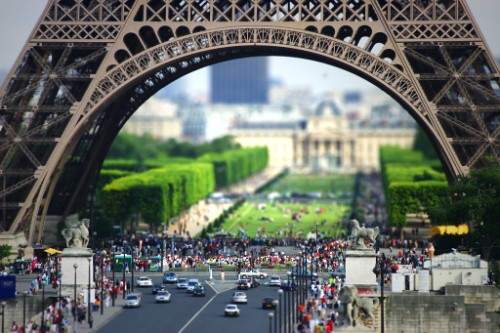
Today, when displaying the results of the previous weeks exercise to one another, and describing our motives and thoughts behind our work, we came across Tilt Shift Photography. This style requires a small D.O.F, and is used to make things appear smaller than they are in reality. The effectiveness of a photograph adopting this style is usually heavily reliant upon its editing in the post-production stages e.g. intensifying the blur of the out-of-focus aspects, and the increasing of saturation to highlight the miniature/toy like styl e of the image. There is also a 'miniature option' on the Nikon D7000 which can help to achieve this style. 


The following are examples of tilt-shift photography:


This style of photography gave me the idea to perhaps focus on important and popular landscapes in London and document these in this particular style. I thought that I may then edit a hand into the image, either painting, gluing, stitching etc. as if this hand had created the landscape. I want this to metaphorically highlight the extent to which a photographer constructs an image, and also wish to ameliorate the importance of these landscapes; thus questioning certain power structures (i.e. a tilt-shift depiction of the house of commons, important financial structures such as gherkin/canary wharf) However, I also toyed with photographing religious buildings such as Church's, Cathedral's, Mosque's etc. and applying the same concept. The obvious problem with this idea would be the accessibility of attaining these photographs from such a high-angle. 

I watched this video to gain a greater understanding of tilt shift photography
http://vimeo.com/27359051


I tried to create the tilt shift effect on Photoshop on some images from Google, after watching this tutorial. These are the results:


This example is from a photo I took. I feel it is not as effective as the angle is not high enough and therefore it is not effective in appearing as a miniature landscape.